

| Mesa [MESA] |
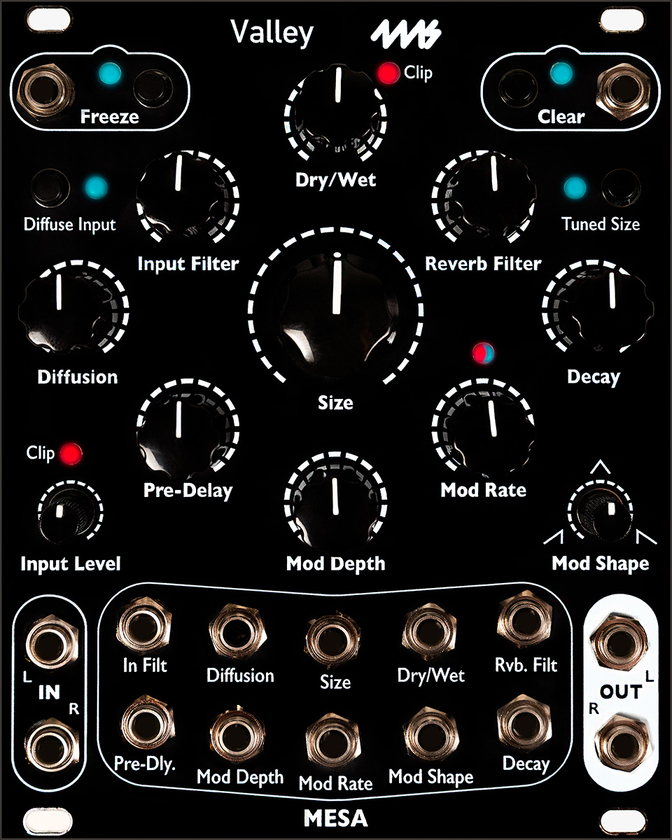
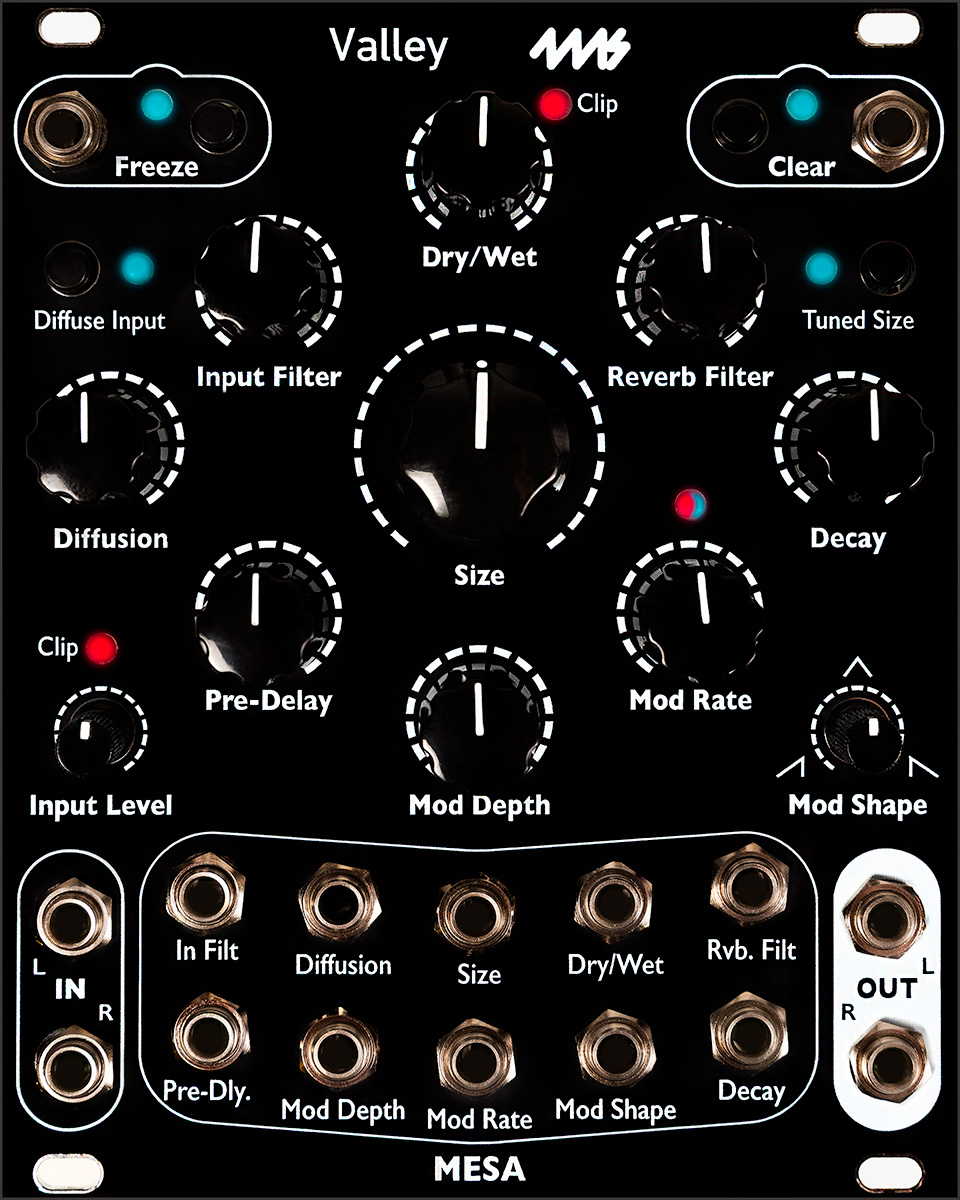
Mesa is a high-fidelity reverb module from 4ms and Valley Audio built around the legendary Dattorro plate reverb algorithm (the same engine powering Valley's beloved VCV Rack module, Plateau). Mesa brings the Plateau sound into hardware with no compromises on quality. Running at 96 kHz with 64-bit double-precision processing, Mesa is among the finest-sounding reverbs available at any price point.
Whether you're breathing life into a dry, static patch or sculpting vast sonic landscapes, Mesa transforms sound with the lush, spacious multi-dimensional character that only a true plate reverb algorithm can deliver.
Much more than just a reverb, the four modulation LFOs, pre-delay buffer, dual filters, and vast reverb network open the door to subtle chorusing, plucked strings, pitched echoes, swirling textures, and deep ventures into genuinely alien sonic territory. Mesa is equally at home as a pristine studio reverb and a tool for deep sound design.
Global release date: October 27th, 2026!
$399.00
- Stereo Inputs and Outputs
- Freeze: holds the reverberations forever. Button can be set to momentary or toggle/latch
- Clear: clears the buffer, canceling all existing reverb and letting new echoes build up. Useful for gated reverbs or purging chaos
- Size: Sets the overall delay time and apparent size of the reverb. Ranges from very short to extremely long.
- Tuned Size button: Shortens the delay times and tunes the all-pass filters to an exponential response so that the reverb can be played with 1V/oct sources
- Diffusion: Controls how diffused and smeared the reverb is. No diffusion results in audible echoes like in a delay effect
- Diffuse Input: Engages the input diffusion stage that pre-diffuses and smears the signal before reverberation. Bypassing the stage sharpens the input signal.
- Decay: Sets the speed at which the signal decays over time. The maximum setting results in a long reverb that evolves over time into a very slowly dying cloud of sound.
- Pre-Delay: Determines the delay for when the original signal is fed into the reverberator. Ranges from 0 to 500ms.
- Input Filter: Filters the incoming signal from low-pass to flat to high-pass
- Reverb Filter: Filters the reverberations from low-pass to flat to high-pass
- Dry/Wet: Control the mix of the original and reverberant signals. Reverb clipping light flashes when clipping at this stage.
- Input Level: Boost/cut the input from -∞ to +3 dB. Input clipping light flashes red when clipping at this stage.
- Mod Depth: Amount of modulation to apply to the left and right delay sections via the four modulation LFOs
- Mod Rate: Speed of the modulation. Each of the four LFO's speed is offset from the others
- Mod Shape: Shape of the modulation LFOs. From rising sawtooth, to triangle, to falling ramp.
Mechanical
- 20HP Eurorack format module
- 0.98” (25mm) maximum depth (including power cable)
Power Consumption
- +12V: 180mA max
- -12V: 36mA max
- +5V: not used
Audio
- Maximum amplitude: +/-9.6V
CV Inputs
- Voltage range -5V to +5V
DSP
- 96kHz sample rate, 24-bit codec with 64-bit double-precision floating point internal processing
- 1GHz Cortex-A7 processor